

Object Record
Images
Metadata
Catalog Number |
1900.001.052 |
Object Name |
Painting |
Collection |
Statehouse Artwork Collection/Governors' Portraits |
Title |
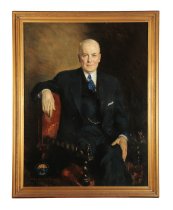
Portrait of George White |
Artist |
Christy, Howard Chandler, 1873-1952 |
Date |
1935 |
Description |
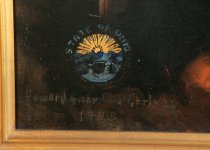
George White, Ohio's 52nd governor (1931--1935), is seen sitting in a Jacobean-style chair with dark wood and red upholstery. He wears a blue three-piece suit with a white shirt and a blue and white polka dot tie. He has a gold watch chain at his waist and a handkerchief in his breast pocket. He has pale white hair. Christy stylized his signature in blue over gold and included a blue and gold seal of the state of Ohio above. |
Material |
Oil Paint/Canvas/Wood |
Notes |
George White was born on August 21, 1872, in Elmira, New York. His father was involved in the oil industry, and when White was two years old, his family moved to Titusville, Pennsylvania, where a great deal of oil drilling was taking place. White attended public schools in Titusville, and he eventually attended Princeton University, graduating in 1895. One of White's instructors at Princeton was Woodrow Wilson. Although White came from a Republican family, he adopted Wilson's political beliefs as his own and became a member of the Democratic Party. Upon graduating, White briefly taught school in Titusville. In 1898, he participated in the Klondike gold rush and amassed a fortune. He invested his funds in the oil industry and owned wells in Ohio, West Virginia, Oklahoma, and Illinois. By 1902, White had settled in Marietta, Ohio. He quickly embarked on a political career, winning election to the Ohio legislature as a Democrat. Once his term expired in 1908, White unsuccessfully sought election to the U.S. House of Representatives, losing by just 57 votes. In 1910, he won election to the U.S. House, carrying his district by 6,000 votes. He won reelection in 1912, lost in 1914, won in 1916, and lost again in 1918. During his tenure in Congress, White served on the Appropriations and the Ways and Means Committees. From 1920 to 1921, White served as chairman of the Democratic National Committee. In 1930, White returned to politics, winning Ohio's governor's seat. He took office in 1931, and he won reelection in 1932. As governor, White had to deal with the Great Depression. He attempted to create numerous relief programs, but he faced opposition from the Republican-controlled legislature, as well as from some opponents within his own party. Upon taking office, White successfully reduced the state budget by twenty million dollars, a fifteen-percent reduction. He also created the Ohio Highway Patrol and implemented sales taxes on cosmetics, cigarettes, and other non-essential items to increase state revenues. In addition to these successes, the governor also implemented the State Relief Commission. In 1934, White sought reelection, but he lost the contest to Republican Martin L. Davey. White sought election to the U.S. Senate in 1936, 1942, and 1948, but he lost all three of these elections. He died on December 15, 1953. |
Provenance |
In 1867, the Ohio General Assembly passed a joint resolution relative to the governors of Ohio. The legislators resolved that "the secretary of state, on the first Monday of January next, whether the portraits of the governors of Ohio, state and territorial, can be procured, and if so, whether original portraits or copies, and the probable expense of procuring such portraits for the governor's office." Howard Chandler Christy painted and signed this portrait of Governor White in 1935. No written documention has been located on this portrait. The Capitol Square Review and Advisory Board took over the care of the Statehouse and its collections in 1988. |
Image size |
50" x 38" |
Frame size |
55-3/4" x 43-3/4" |
Frame desc |
Twentieth century gilt molded frame |
People |
Christy, Howard Chandler, 1873-1952 White, George 1873-1952 |
Search Terms |
Great Seal of the State of Ohio Ohio Governor Ohio Governor's Portraits |
Subjects |
Governors Painting Portrait paintings |