

Object Record
Images
Metadata
Catalog Number |
1900.001.068 |
Object Name |
Painting |
Collection |
Statehouse Artwork Collection/Governors' Portraits |
Title |
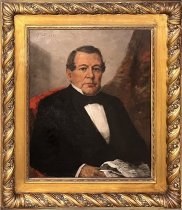
Portrait of Thomas Corwin |
Artist |
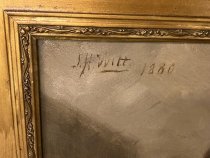
Witt, John Henry, 1840-1901 |
Date |
1880 |
Description |
Thomas Corwin, Ohio's fifteenth governor (1840-1842), is seen seated in a red chair with what appears to be a drapery on the right and a doorway on the left. He is holding what looks like a newspaper. He wears a black coat with a white shirt and a black tie. He has medium-length dark hair parted on the left. |
Material |
Oil Paint/Canvas/Wood |
Notes |
Thomas Corwin was the fifteenth governor of Ohio and a prominent American political leader in the years before the American Civil War. Corwin was born in Bourbon County, Kentucky, in 1794. The Corwin family moved to Lebanon, Ohio, in 1798, where Thomas Corwin's father, Mathias, was later elected to eleven consecutive terms as a state representative. As a result, Corwin grew up with an interest in politics and the law. As a young man, Corwin studied the law and he was admitted to the Ohio Bar in 1817. He practiced law in Lebanon and soon became prosecuting attorney of Warren County. He held that position from 1818 to 1828. In addition to his law practice, Corwin also soon became involved in politics. Warren County residents elected him to the Ohio House of Representatives from 1821 to 1823 and again from 1829 to 1830. In the meantime, he married Sarah Ross, originally from Chester County, Pennsylvania, on November 13, 1822. They had five children. Corwin became associated with the Whig Party in the 1830s and he was elected to five straight terms in the United States House of Representatives during that decade. He earned a nickname of "the terror of the house" because of his reputation for spirited and witty debate in the House of Representatives. Corwin resigned from Congress in 1840 to run for governor of Ohio. Corwin defeated incumbent Wilson Shannon, becoming Ohio's fifteenth governor. In addition to winning his own election, Corwin also contributed to William Henry Harrison's successful campaign for the presidency. He became well known by making many articulate speeches across the state of Ohio. In this way he earned a positive reputation, which he maintained the rest of his life. Although Corwin had won election, he found that his time as governor would not be easy. He and other Whigs wanted to create a state bank, but Democrats dominated both houses within the state legislature. They defeated his plans for the bank. Because the state was still in an economic downturn, Corwin and the Whig Party received much of the blame for not creating solutions. In the election of 1842, Wilson Shannon ran against Corwin and won. In 1844, the Whigs returned to power, and Corwin became a United States senator. As a senator, he opposed the Mexican War. This stand gained him national attention. Corwin served in the Senate from 1845 until July 20, 1850, when President Millard Fillmore appointed him Secretary of the Treasury. In 1853, Corwin retired from politics and returned to his law practice in Lebanon, Ohio. Corwin's retirement did not mean the end of his political career. By the 1850s, the Whig Party was coming apart because of internal disagreements about slavery. Corwin joined the new Republican Party and returned to Congress in 1859. Corwin campaigned vigorously for Abraham Lincoln in the presidential election of 1860, although he initially sought the Republican Party's presidential nomination for Ohioan John McLean. After Lincoln was elected, he appointed Corwin as Minister to Mexico, a post that he held from 1861 to 1864. Corwin was popular in Mexico. He helped the United States maintain a strong relationship with that nation throughout the Civil War, in part because of his earlier opposition to the Mexican War. Corwin retired to Washington, DC, in 1864, where he practiced law until his death on December 18, 1865. |
Provenance |
A newspaper article from August 1899 reads, "The portrait of Governor Tom Corwin, presented to the state on Wednesday evening by Thomas Wilson, of the Smithsonian Institution at Washington, was hung at the governor's office yesterday. The painting occupies a position such that no one can fail to see it upon entering the room... The portrait which is a most excellent one, is the work of J. H. Witt, who formerly made his home In Columbus." The portrait was originally hung in the governor's office and remained there until at least 1911. This painting was taken into the care of the Ohio Historical Society (now the Ohio History Connection) when the Ohio Statehouse became one of their historic sites and was in their collections until 2022, when it was returned to the Ohio Statehouse and into the care of CSRAB. The Capitol Square Review and Advisory Board took over the care of the Statehouse and its collections in 1988. |
Image size |
22" x 18" |
Frame size |
30-1/2" x 26-1/4" |
People |
Corwin, Thomas, 1794-1865 Witt, John H. |
Search Terms |
Ohio Governor Ohio Governor's Portraits |
Subjects |
Governors Painting Portrait paintings |