

Object Record
Images
Metadata
Catalog Number |
2017.009.001 |
Object Name |
Portrait |
Collection |
2017.009 |
Title |
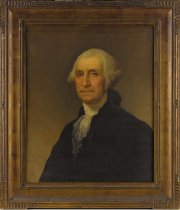
Portrait of George Washington (after Gilbert Stuart) |
Artist |
Lambdin, James Reid, 1807-1889 |
Date |
Unknown |
Description |
Bust portrait of George Washington painted after the Lansdowne portrait by Gilbert Stuart. |
Dimensions |
H-39 W-33.5 inches |
Material |
Canvas |
Notes |
George Washington served as the first president of the United States of America. Born in 1732 into a Virginia planter family, he learned the morals, manners, and body of knowledge requisite for an 18th century Virginia gentleman. As a young man, he pursued two intertwined colonial interests: military arts and western expansion. At the age of 16 he helped survey Shenandoah lands for Thomas, Lord Fairfax. He was commissioned a lieutenant colonel for the British army in 1754, and fought in the first skirmishes of what would become the French and Indian War. In 1755, while serving as an aide to Gen. Edward Braddock, he narrowly escaped injury during battle; four bullets ripped through his coat and two horses were shot out from under him. From 1759 to the outbreak of the American Revolution, Washington lived at his home, Mount Vernon, where he managed his land and served in the Virginia House of Burgesses. He was married to a widow, Martha Dandridge Custis, and he devoted himself to a busy and happy life. However, like many of his fellow planters, Washington believed he was exploited by British merchants and restricted by British regulations. As quarrels with the mother country grew, Washington became a moderate but firm voice of the resistance movement. When the Second Continental Congress assembled in Philadelphia in May 1775, Washington, one of the Virginia delegates, was elected Commander in Chief of the Continental Army. On July 3, 1775, at Cambridge, Massachusetts, he took command of his ill-trained troops and embarked upon a war that was to last six grueling years. Early in the war effort, Washington realised that his best strategy was to harass the British. He reported to Congress, “we should on all Occasions avoid a general Action, or put anything to the Risque, unless compelled by a necessity, into which we ought never to be drawn.” Ensuing battles saw him fall back slowly, then strike unexpectedly. He dealt with harsh winters, disease, inexperience, desertion among the troops, and lack of financial support. In spite of all the difficulties the Continental Army faced, Washington forced the surrender of Cornwallis at Yorktown in 1781 with aide from France. After years of war, Washington most longed to retire to his fields at Mount Vernon, but he soon realized that the new nation was not functioning well under the Articles of Confederation. Thus, he became a key player in the Constitutional Convention at Philadelphia in 1787. When the new Constitution of the United States was ratified, the Electoral College unanimously elected Washington as president. Under Washington, the determination of foreign policy became primarily a presidential matter. When the French Revolution led to war between France and England, he chose neutrality over either the recommendations of his Secretary of State Thomas Jefferson, who was pro-French, or his Secretary of the Treasury Alexander Hamilton, who was pro-British. He felt that is was not wise for the United States to take sides until it had the opportunity to grow stronger. To his disappointment, two clearly defined political parties were developing by the end of his first term. Weary of politics, he retired at the end of his second term in office. In his Farewell Address, he urged his countrymen to forswear excessive party spirit and geographical distinctions. In foreign affairs, he warned against long-term alliances. Washington enjoyed fewer than three years of retirement at Mount Vernon; he died of a throat infection December 14, 1799. For months the nation mourned his loss. Biographical information provided by The White House. |
Provenance |
This portrait was donated by Jim Dicke II via the Crown Equipment Corporation to the Capitol Square Review and Advisory Board in 2017. The Capitol Square Review and Advisory Board took over the care of the Statehouse and its collections in 1988. |
Image size |
29" x 24" |
Frame size |
39" x 33.5" |
Frame desc |
Wood |
People |
Washington, George, 1732-1799 |
Subjects |
Copy art Portrait paintings Presidents |